
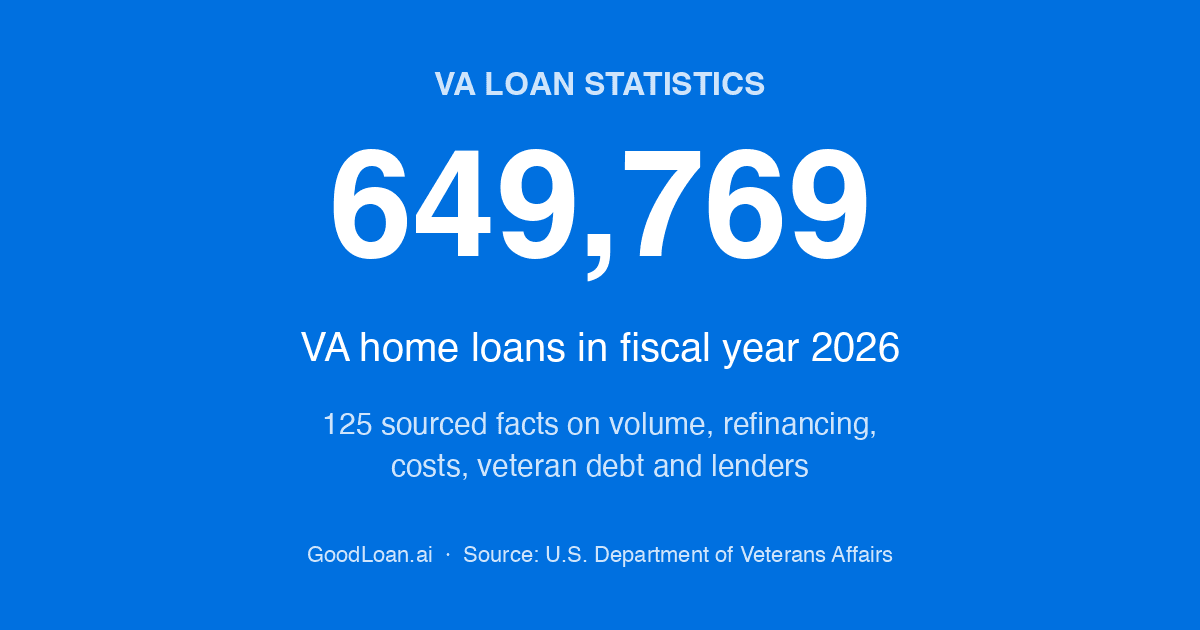
Updated November 2026. Refreshed monthly.
The VA loan program moves faster than almost any other part of the mortgage market. In fiscal year 2021 the VA backed 1,441,745 home loans, and two years later it backed 400,695 (VA Annual Benefits Report, May 2026). Now the count is climbing again.
Most pages about VA loans stop at the mortgage. That is half the picture. A veteran household also carries cards, car loans and personal loans, and those cost far more than the mortgage does. So this page puts both halves side by side: the loan program, and the debt that sits next to it.
Every number below links to the group that produced it: the VA, the Federal Reserve, the Government Accountability Office, the Bureau of Labor Statistics and the researchers who ran the surveys. No roundups, no copies of copies.
Key Takeaways
- The VA backed 649,769 home loans worth $263.1 billion in fiscal year 2026, which ran from October 2025 through September 2026 (VA Lender Loan Volume, Sep 2026).
- VA loan volume grew 26.9% in fiscal year 2025, to 528,340 loans (VA Annual Benefits Report, May 2026).
- 74% of VA home purchases in fiscal year 2025 had no down payment (VA Annual Benefits Report, May 2026).
- VA rate-reduction refinances went from 5,000 in fiscal year 2023 to 207,416 in fiscal year 2026 (VA Lender Loan Volume, Sep 2026).
- Veterans took 98,827 VA cash-out refinances in fiscal year 2026, averaging $373,252 each (VA Lender Loan Volume, Sep 2026).
- The average credit card rate is 21.19% (Federal Reserve, Sep 2026).
- The average 30-year fixed mortgage rate is 7.28%, up from 6.26% a year ago (Freddie Mac, Nov 2026).
- 35% of veterans carry credit card debt, against 27% of matched non-veterans (Medical Care, Dec 2024).
- 4.99% of VA loans were behind on payments in early 2026, against 11.88% of FHA loans (MBA, May 2026).
- 4,051,533 VA-backed loans were active in mid-2026 (GAO, Nov 2026).
- Two lenders made 28.2% of all VA loans in fiscal year 2026 (VA Lender Loan Volume, Sep 2026).
- Home equity line balances reached $481 billion after 18 straight quarterly increases (New York Fed, Nov 2026).
- The VA funding fee is 0.5% on a rate-reduction refinance and 2.15% on a first-use purchase with under 5% down (VA.gov, Apr 2023).
- The VA helped 173,478 borrowers keep their homes or avoid foreclosure in fiscal year 2025, saving an estimated $9.9 billion in foreclosure costs (VA Annual Benefits Report, May 2026).
How Big Is the VA Loan Program?
The VA loan program is not a niche benefit. It is one of the largest home lending channels in the country, and it swings harder with interest rates than most people expect.
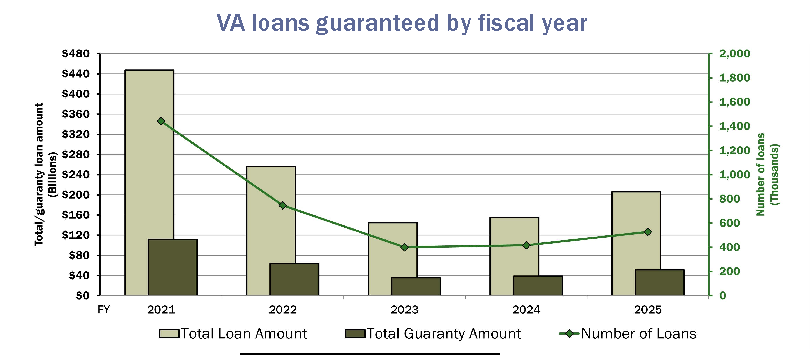
Figure 1: VA loan volume fell by more than two thirds after 2021 and has been rebuilding since 2023, which shows how tightly the program tracks interest rates. Source: U.S. Department of Veterans Affairs, Annual Benefits Report Fiscal Year 2025, Loan Guaranty, May 2026. Screenshot of the source page, captured 16 Nov 2026.
How many VA loans are made each year?
More than half a million in each of the last two fiscal years, and the count is rising.
- The VA guaranteed 416,376 loans in fiscal year 2024 (VA Annual Benefits Report, May 2026).
- Fiscal year 2026 volume was 23.0% above fiscal year 2025 (VA Lender Loan Volume, Sep 2026).
- Just over half of fiscal year 2026 VA loans, 52.9%, were home purchases (VA State Loan Volume, Sep 2026).
How much money do VA loans add up to?
Hundreds of billions of dollars a year, on loans that keep getting larger.
- VA loans totaled $206.1 billion in fiscal year 2025 (VA Annual Benefits Report, May 2026).
- The average VA loan was $390,101 in fiscal year 2025 (VA Annual Benefits Report, May 2026).
- The average VA loan was $310,174 in fiscal year 2021, so the typical loan grew 25.8% in four years (VA Annual Benefits Report, May 2026).
- The average VA loan reached $404,891 in fiscal year 2026 (VA Lender Loan Volume, Sep 2026).
- The VA's guaranty on fiscal year 2025 loans came to $51.06 billion, or $96,648 per loan on average (VA Annual Benefits Report, May 2026).
How many VA loans are open right now?
About four million, and the VA stands behind a slice of each one.
- 3,620,998 VA-backed loans were active in early 2022, so the active book has grown by about 430,000 loans since (GAO, Nov 2026).
- VA loans outstanding totaled $1.04 trillion at the end of fiscal year 2024, with $261.8 billion of that guaranteed (CRS, May 2026).
- On loans over $144,000, the VA guarantees up to 25% of the loan amount to the lender (VA.gov, Aug 2025).
Who Uses VA Loans?
The picture of the VA borrower as a young first-time buyer is out of date. Most VA home buyers have owned before, and more than a quarter of all VA borrowers are over 55.
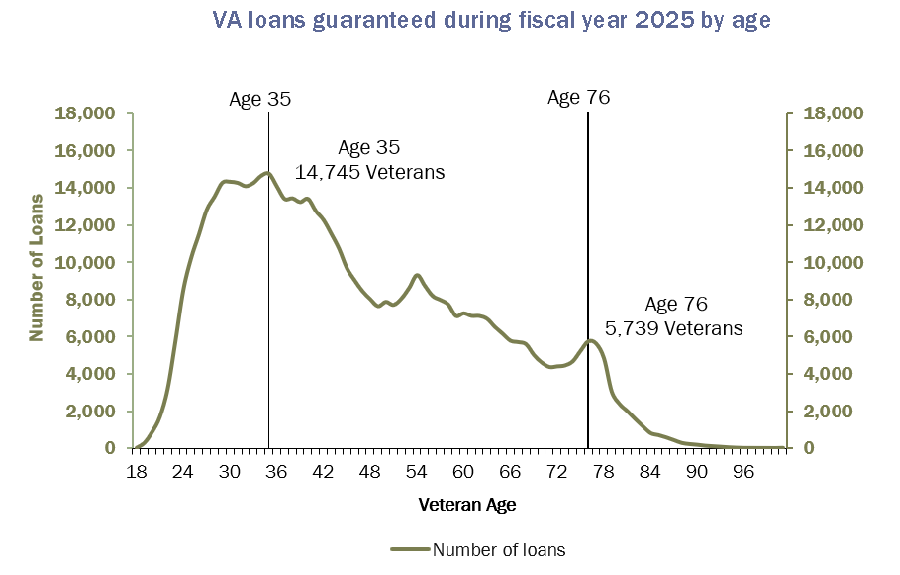
Figure 2: VA borrowing peaks in the mid-thirties but never stops, with a second bump in the mid-seventies, so this is a benefit people use across their whole lives. Source: U.S. Department of Veterans Affairs, Annual Benefits Report Fiscal Year 2025, Loan Guaranty, May 2026. Screenshot of the source page, captured 16 Nov 2026.
Are most VA borrowers first-time buyers?
No. Repeat buyers outnumber first-time buyers by about three to two.
- 130,238 VA purchase loans went to first-time home buyers in fiscal year 2025 (VA Annual Benefits Report, May 2026).
- 193,594 went to people who had owned before, which is 59.8% of VA purchase loans (VA Annual Benefits Report, May 2026).
- First-time buyers borrowed $349,442 on average, and repeat buyers borrowed $431,362 (VA Annual Benefits Report, May 2026).
- The 83,083 buyers who did make a down payment borrowed $444,747 on average, more than buyers who put nothing down (VA Annual Benefits Report, May 2026).
How old are VA borrowers?
They span every adult age group. The largest group is 26 to 35, but older veterans are a big share.
- Borrowers aged 26 to 35 took 26.2% of fiscal year 2025 VA loans, the largest share of any age group (VA Annual Benefits Report, May 2026).
- Borrowers aged 36 to 45 took 23.5% and had the largest average loan, $442,479 (VA Annual Benefits Report, May 2026).
- Borrowers aged 56 and older took 28.7% of fiscal year 2025 VA loans (VA Annual Benefits Report, May 2026).
- The single most common borrower age was 35, with 14,745 loans (VA Annual Benefits Report, May 2026).
- The share of VA loans going to 18 to 25 year olds rose from 3.0% in fiscal year 2021 to 5.8% in fiscal year 2025 (VA Annual Benefits Report, May 2026).
What do VA borrowers earn?
More than most people guess, with thin savings next to it.
- VA home buyers had a median income of $110,400 in fiscal year 2025 (VA Annual Benefits Report, May 2026).
- Their median assets were $19,939 (VA Annual Benefits Report, May 2026).
- 10,351 VA buyers earned under $50,000, and their average loan was $181,485 (VA Annual Benefits Report, May 2026).
- 37,714 VA buyers earned $200,000 or more, and their average loan was $679,214 (VA Annual Benefits Report, May 2026).
How many people can use a VA loan?
Millions, and half of last year's borrowers were using the benefit again.
- 50.2% of fiscal year 2025 VA loans, 265,411 of them, used restored entitlement, meaning the borrower had used the benefit before (VA Annual Benefits Report, May 2026).
- People still serving took 77,098 VA loans, or 14.6% (VA Annual Benefits Report, May 2026).
- Gulf War era veterans took 27.9% (VA Annual Benefits Report, May 2026).
- 17.3 million men and women in the United States were veterans in 2025 (BLS, Apr 2026).
- The veteran unemployment rate was 3.5% in 2025, below the 4.2% rate for non-veterans (BLS, Apr 2026).
- 34% of veterans had a service-connected disability in August 2025 (BLS, Apr 2026).
- Veterans who served after September 2001 had an unemployment rate of 3.6% (BLS, Apr 2026).
How Common Is VA Refinancing?
Refinancing is where the VA program changes shape from one year to the next. Rate-reduction loans come and go with the market. Cash-out loans are steadier, because the reason for them is steadier: debt that costs more than the mortgage.
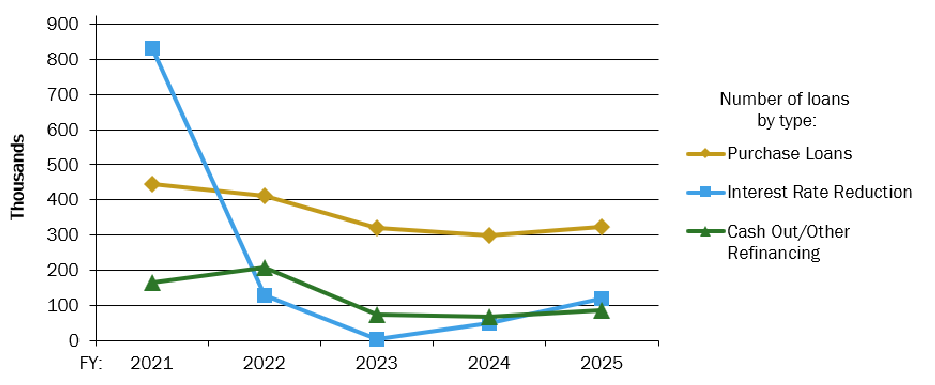
Figure 3: Rate-reduction refinances collapsed from the 2021 peak and came back in 2025, while cash-out refinances held a much narrower range, which is the pattern you would expect when one follows rates and the other follows household debt. Source: U.S. Department of Veterans Affairs, Annual Benefits Report Fiscal Year 2025, Loan Guaranty, May 2026. Screenshot of the source page, captured 16 Nov 2026.
How many veterans refinance each year?
It depends almost entirely on rates. In a low-rate year, refinances outnumber purchases.
- All refinances made up 38.7% of VA loan volume in fiscal year 2025 (VA Annual Benefits Report, May 2026).
- The VA guaranteed 119,458 rate-reduction refinances in fiscal year 2025, or 22.6% of all VA loans (VA Annual Benefits Report, May 2026).
- At the fiscal year 2021 peak, the VA guaranteed 831,824 rate-reduction refinances (VA Annual Benefits Report, May 2026).
- Rate-reduction refinances were 31.9% of VA loans in fiscal year 2026 (VA State Loan Volume, Sep 2026).
- The average rate-reduction refinance was $410,565 in fiscal year 2026 (VA Lender Loan Volume, Sep 2026).
How big is a typical VA cash-out refinance?
Around $360,000 to $375,000, and the yearly total runs into the tens of billions.
- The VA guaranteed 85,050 cash-out refinances in fiscal year 2025, averaging $357,526 and totaling $30.4 billion (VA Annual Benefits Report, May 2026).
- Cash-out refinances peaked at 207,777 in fiscal year 2022 (VA Annual Benefits Report, May 2026).
- VA cash-out refinances totaled $36.9 billion in fiscal year 2026 (VA Lender Loan Volume, Sep 2026).
- The number of VA cash-out refinances rose 16.2% from fiscal year 2025 to fiscal year 2026 (VA Lender Loan Volume, Sep 2026).
- Cash-out refinances were 15.2% of all VA loans in fiscal year 2026 (VA State Loan Volume, Sep 2026).
What can a VA cash-out refinance be used for?
The VA names paying off debt first.
- The VA says a cash-out refinance lets you take cash out of your home equity to pay off debt, pay for school, make home improvements or take care of other needs, and you must live in the home (VA.gov, Jan 2026).
- In Texas, only 1,097 of 66,131 VA loans in fiscal year 2026 were cash-out refinances, or 1.7%, far below every other large state (VA State Loan Volume, Sep 2026).
- Florida had 8,002 VA cash-out refinances in fiscal year 2026, the most of any state (VA State Loan Volume, Sep 2026).
If you want to see what your own numbers look like with every debt in one plan, we build that at va.goodloan.ai. Call, text or chat (866) 599-0088, 8am to 8pm Eastern.
How Much Debt Do Veteran Households Carry?
Military households are not short on income or discipline. On most measures they are ahead of civilians. The strain shows up somewhere else: in card balances carried month to month, at rates nobody was ever taught to count as part of their real cost of borrowing.
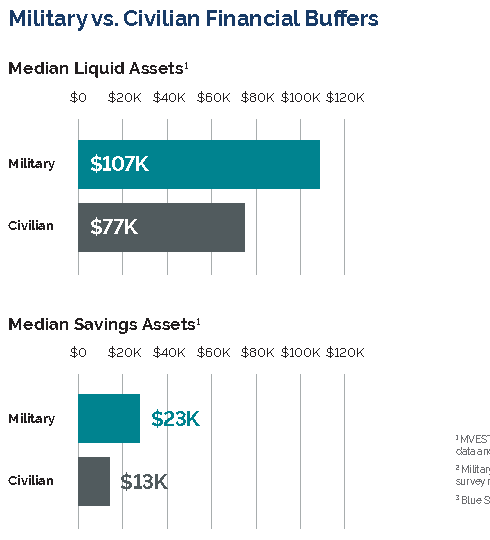
Figure 4: Military-affiliated households hold larger cash buffers than civilian households, which makes the card balances many of them still carry month to month stand out even more. Source: The USAA Educational Foundation, 2025 State of Personal Finance in the Military Community, Apr 2026. Screenshot of the source page, captured 16 Nov 2026.
How many veterans have credit card debt?
More than a third, and veterans are more likely than similar civilians to carry it.
- 19% of veterans had unpaid credit card balances, against 14% of non-veterans matched on age, sex, education, race and region (Medical Care, Dec 2024).
- 6.8% of veterans had used a payday or pawn shop loan, against 3.3% of matched non-veterans (Medical Care, Dec 2024).
- Medical debt was about the same for both groups, 10.9% of veterans and 9.4% of non-veterans, in a study of 1,176 veterans drawn from the Federal Reserve's household survey (Medical Care, Dec 2024).
- 44% of military-affiliated households carry a credit balance from month to month (USAA Educational Foundation, Apr 2026).
- 90% of service members carry household debt, against 75% of the general population, in a Harris Poll survey (NFCC, Jul 2025).
How stressed are military and veteran families about money?
Enough that it follows people out of the service.
- 50% of active-duty service members say they are just getting by financially (NFCC, Jul 2025).
- 40% of veterans worry more about their financial future now than they did on active duty (NFCC, Jul 2025).
- 63% of veterans want more financial resources made for their situation (NFCC, Jul 2025).
- 65% of service members are comfortable using their maximum credit, against 37% of the general population (NFCC, Jul 2025).
- 27% of veteran family respondents said they were finding it difficult to get by or just getting by, in a survey with 2,846 veteran family respondents (Blue Star Families and IVMF, Feb 2026).
- 59% of recently separated veterans who needed financial planning help did not receive it (Blue Star Families and IVMF, Feb 2026).
- 58% of veteran family respondents described the move to civilian life as difficult or very difficult (Blue Star Families and IVMF, Feb 2026).
Do military households have a financial cushion?
On average, yes, and a bigger one than civilians.
- Median household income is $105,000 for military-affiliated households and $95,000 for civilian households (USAA Educational Foundation, Apr 2026).
- Median savings are $23,000 for military-affiliated households and $13,000 for civilian households (USAA Educational Foundation, Apr 2026).
- Median liquid assets are $107,000 against $77,000 (USAA Educational Foundation, Apr 2026).
- Average credit scores are 727 for military-affiliated households and 715 for civilians (USAA Educational Foundation, Apr 2026).
- Only 43% of military households could cover three months of expenses from their checking balance (USAA Educational Foundation, Apr 2026).
Your mortgage might be fine. It is still only half of your finances. We build a plan around all of it at va.goodloan.ai, with no impact on your credit score to see your numbers.
What Does Carrying Card Debt Next to a Mortgage Cost?
People guard a low mortgage rate and stop counting the cards beside it. The gap between what a home loan costs and what a credit card costs is the widest gap in household finance, and it is where the money goes.
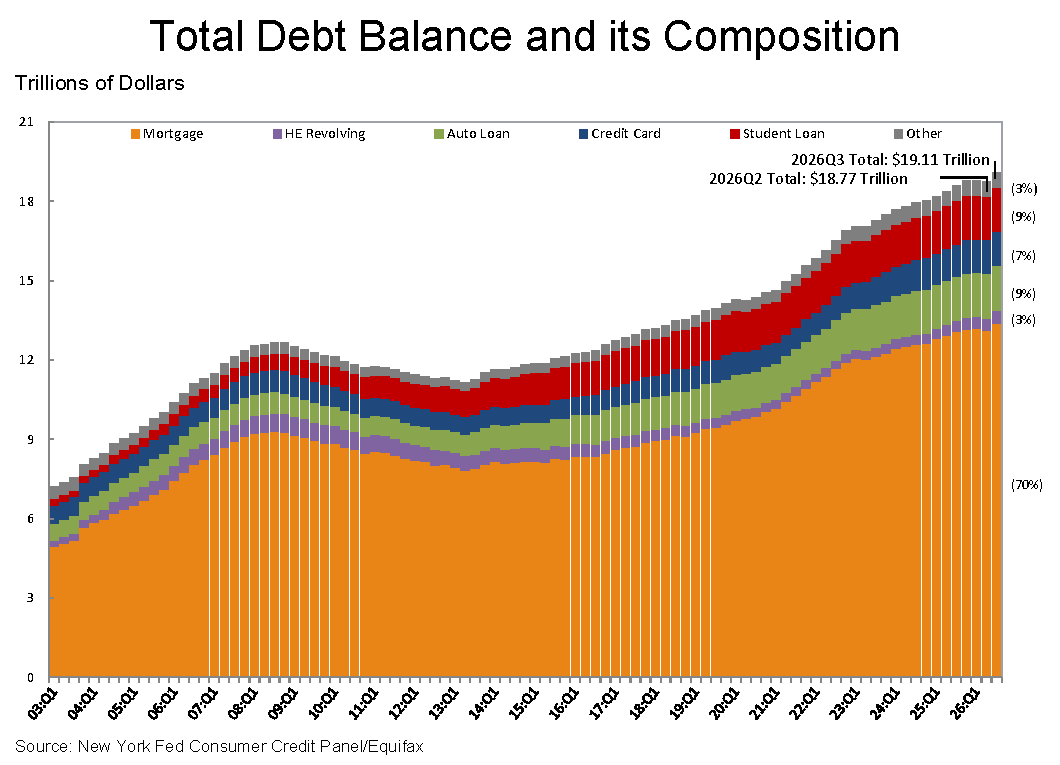
Figure 5: Mortgages are 70% of what households owe, yet the smaller card and loan slices carry the highest interest rates, so the true cost of a household's debt is set by more than its mortgage. Source: Federal Reserve Bank of New York, Quarterly Report on Household Debt and Credit 2026 Q3, Nov 2026. Screenshot of the source page, captured 16 Nov 2026.
What interest rate do people pay on credit cards?
About three times the rate on a new 30-year mortgage.
- On card accounts that were actually charged interest, the average rate was 22.36% (Federal Reserve, Sep 2026).
- The average rate on a 24-month personal loan from a bank was 11.90% (Federal Reserve, Sep 2026).
- Revolving consumer credit outstanding, which is mostly credit cards, was $1,368.5 billion (Federal Reserve, Sep 2026).
- The average 15-year fixed mortgage rate was 6.66%, up from 5.54% a year earlier (Freddie Mac, Nov 2026).
How much do American households owe?
More than $19 trillion, and the total is still rising.
- Total household debt rose $334 billion in the third quarter of 2026 to $19.11 trillion (New York Fed, Nov 2026).
- Mortgage balances were $13.4 trillion at the end of September 2026 (New York Fed, Nov 2026).
- Credit card balances stood at $1.29 trillion, up $22 billion in one quarter (New York Fed, Nov 2026).
- 5.0% of outstanding household debt was in some stage of delinquency (New York Fed, Nov 2026).
- Credit card limits rose by $115 billion in the quarter (New York Fed, Nov 2026).
- Home equity line limits rose by $31 billion, or 2.9% (New York Fed, Nov 2026).
- About 135,000 consumers had a bankruptcy added to their credit report in the quarter (New York Fed, Nov 2026).
- 4.9% of consumers had an account in third-party collection (New York Fed, Nov 2026).
How much room do households have for a surprise bill?
Less than the income numbers suggest.
- 63% of adults said they would cover a $400 emergency expense entirely with cash or its equivalent (Federal Reserve SHED, May 2026).
- 73% of adults said they were doing okay financially or living comfortably in 2025 (Federal Reserve SHED, May 2026).
What Does a VA Loan Cost?
A VA loan has one cost no other loan has, the funding fee, and it skips two costs most other loans carry: a down payment and monthly mortgage insurance. Knowing which fee applies to which loan matters more than the headline rate.
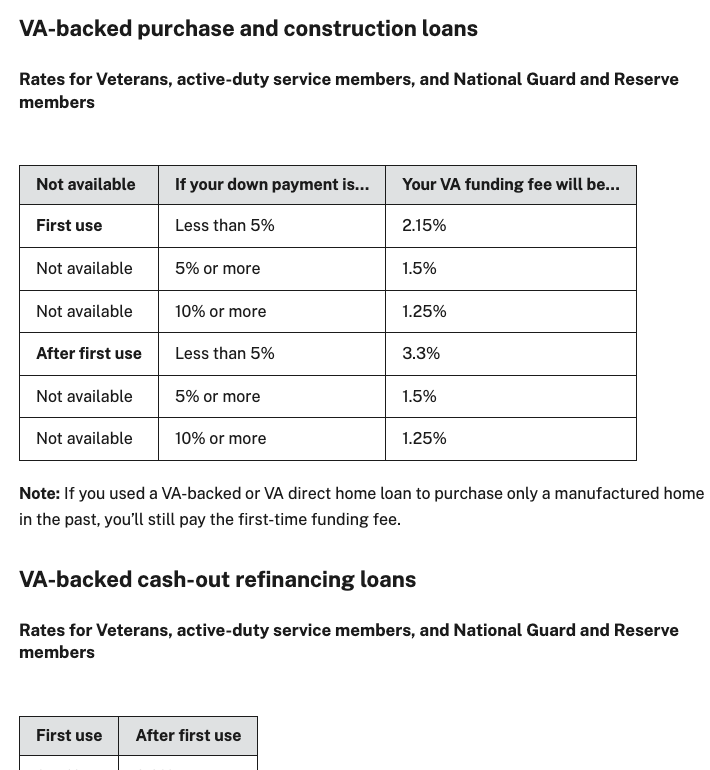
Figure 6: The funding fee depends on the loan type, whether it is a first use, and the down payment, so two veterans with the same loan amount can pay very different fees. Source: U.S. Department of Veterans Affairs, VA Funding Fee And Loan Closing Costs, Apr 2023. Screenshot of the source page, captured 16 Nov 2026.
How much is the VA funding fee?
Between 0.5% and 3.3% of the loan, and some veterans pay nothing.
- After first use, the fee on a purchase with under 5% down is 3.3% (VA.gov, Apr 2023).
- A down payment of 5% or more cuts the purchase fee to 1.5%, and 10% or more cuts it to 1.25% (VA.gov, Apr 2023).
- On a cash-out refinance the fee is 2.15% on first use and 3.3% after, whatever the equity in the home (VA.gov, Apr 2023).
- Veterans who receive VA disability compensation, and surviving spouses who receive Dependency and Indemnity Compensation, do not pay the fee (VA.gov, Apr 2023).
Is there a limit on a VA loan?
Not for most borrowers.
- A veteran with full entitlement has no VA loan limit, as long as they can afford the loan and the appraisal supports the price (VA.gov, Aug 2025).
- For veterans with part of their entitlement in use, the limit follows the national conforming loan limit, which is $832,750 for a one-unit home in 2026 (FHFA, Nov 2025).
- That limit rose $26,250 from 2025 because house prices rose 3.26% on average (FHFA, Nov 2025).
- In high-cost areas the ceiling is $1,249,125 (FHFA, Nov 2025).
How Do VA Loans Perform?
VA loans are made with no down payment, and they still perform far better than the other government-backed option. Late payments have been edging up, though, and foreclosures rose sharply in 2025.
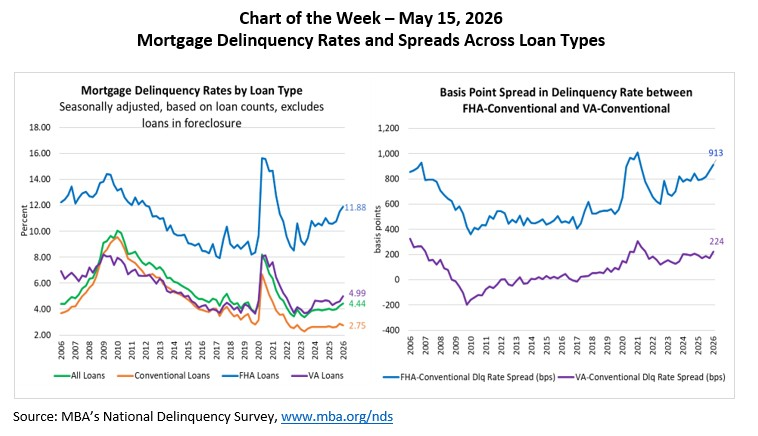
Figure 7: VA loans have tracked much closer to conventional loans than to FHA loans for two decades, even though most VA buyers put nothing down. Source: Mortgage Bankers Association, Chart of the Week: Mortgage Delinquency Rates and Spreads Across Loan Type, May 2026. Chart published by the source, captured 16 Nov 2026.
How often do VA borrowers fall behind?
About one loan in twenty is late, and about one in forty is two or more months late.
- The delinquency rate on conventional loans was 2.75% in the first quarter of 2026 (MBA, May 2026).
- The VA delinquency rate rose 39 basis points in that quarter, which is 0.39 of a percentage point (MBA, May 2026).
- The delinquency rate across all mortgage types was 4.44% (MBA Chart of the Week, May 2026).
- The gap between VA and conventional delinquency rates was 224 basis points (MBA Chart of the Week, May 2026).
- 95,282 VA-backed loans were two or more months behind in the second quarter of 2026, and 87,425 of those were three or more months behind (GAO, Nov 2026).
- That was down from 99,210 one quarter earlier (GAO, Nov 2026).
How many VA loans end in foreclosure?
A few thousand a quarter, out of about four million loans.
- 3,575 foreclosures were completed on homes with VA-backed loans in the second quarter of 2026 (GAO, Nov 2026).
- Completed foreclosures jumped from 1,420 in the first quarter of 2025 to 3,390 in the second (GAO, Nov 2026).
- The VA foreclosure rate reached its highest level since the second quarter of 2017 (MBA, May 2026).
- In fiscal year 2025 the VA took two months on average to sell a foreclosed property after acquiring it (CRS, May 2026).
What help do VA borrowers get when they fall behind?
Several options, and a new one arrived in 2026.
- In the second quarter of 2026, VA borrowers received 4,516 special forbearances, 3,522 loan modifications and 2,390 repayment plans (GAO, Nov 2026).
- From May 31, 2024 to May 1, 2025 the VA bought defaulted loans from servicers and modified them to a fixed 2.5% rate (GAO, Nov 2026).
- The VA's Partial Claim Program took effect on June 15, 2026, and servicers must offer it by November 28, 2026 (GAO, Nov 2026).
- An earlier pandemic-era partial claim program covered about 52,000 loans and cost the VA about $139 million in contracting (GAO, Nov 2026).
- Lenders denied 113,779 applications for VA-backed loans in 2025, a count that can include repeat applications from the same person (GAO, Nov 2026).
Who Makes VA Loans?
More than a thousand lenders make VA loans, but a handful make most of them. The lender a veteran ends up with depends heavily on which kind of loan they want.
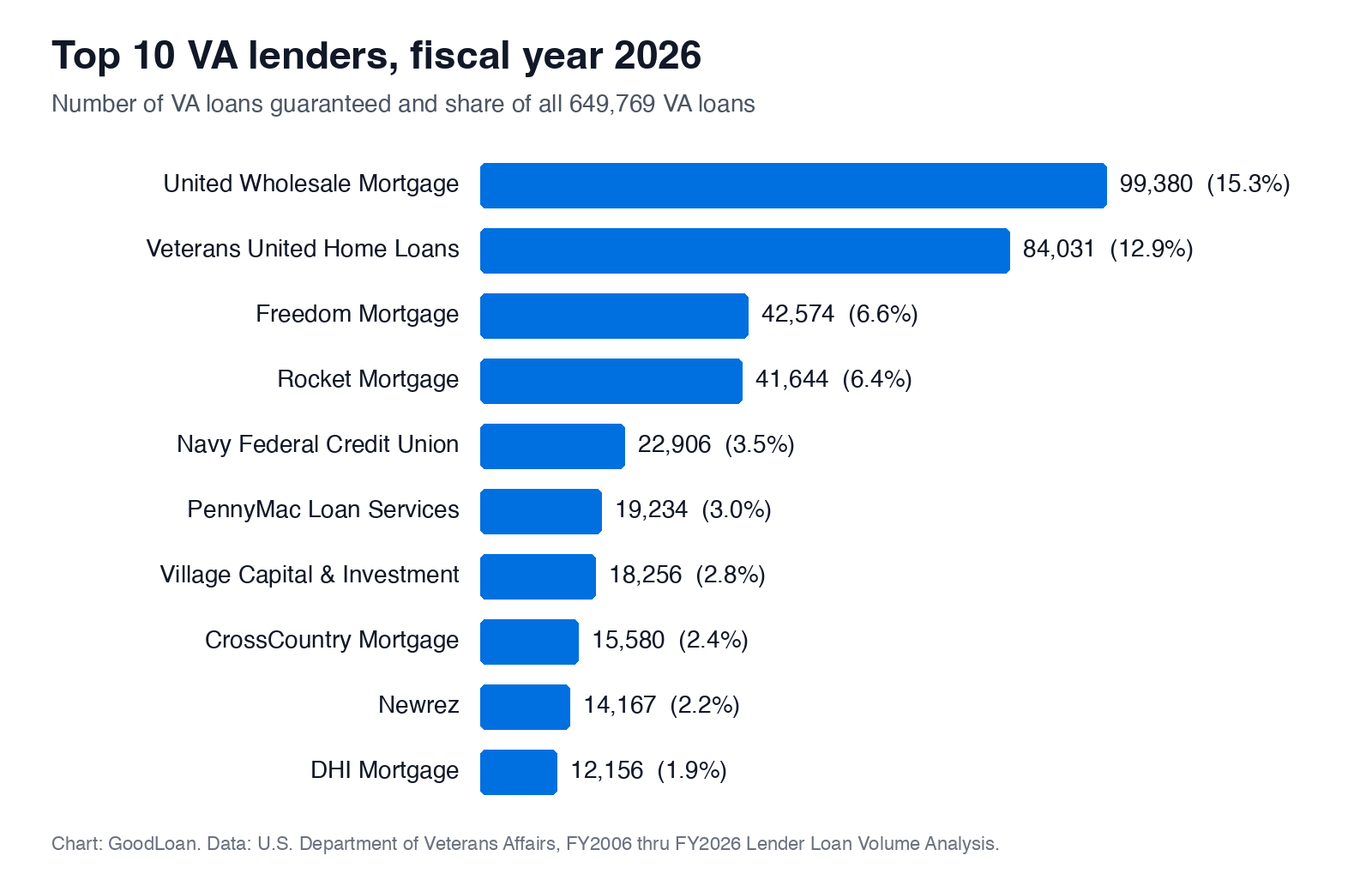
Figure 8: Two lenders stand far ahead of the rest, and the tenth-largest lender makes about an eighth of what the largest does, so the VA market is much more top-heavy than its lender count suggests. Source: U.S. Department of Veterans Affairs, FY2006 thru FY2026 Lender Loan Volume Analysis, Sep 2026. Chart drawn by GoodLoan from the source's data, 16 Nov 2026.
Who are the biggest VA lenders?
United Wholesale Mortgage and Veterans United, by a wide margin.
- 1,142 lenders made at least one VA loan in fiscal year 2026 (VA Lender Loan Volume, Sep 2026).
- The ten largest lenders made 56.9% of all VA loans (VA Lender Loan Volume, Sep 2026).
- United Wholesale Mortgage made 99,380 VA loans in fiscal year 2026, up from 59,294 the year before (VA Lender Loan Volume, Sep 2026).
- Veterans United made 67,658 VA purchase loans, or 19.7% of all VA purchases (VA Lender Loan Volume, Sep 2026).
- Navy Federal Credit Union made 22,906 VA loans, the most of any credit union (VA Lender Loan Volume, Sep 2026).
Is VA refinancing more concentrated than VA home buying?
Yes, much more.
- The ten largest lenders made 78.9% of VA rate-reduction refinances, and one lender made 26.2% on its own (VA Lender Loan Volume, Sep 2026).
- Two lenders made 32.1% of VA cash-out refinances between them (VA Lender Loan Volume, Sep 2026).
- 822 lenders made at least one VA cash-out refinance, against 1,081 that made a VA purchase loan (VA Lender Loan Volume, Sep 2026).
Which states have the most VA loans?
Texas and Florida lead, and loan sizes vary by more than two to one.
- Texas had 66,131 VA loans in fiscal year 2026 and Florida had 56,399 (VA State Loan Volume, Sep 2026).
- North Carolina had 40,365 and Virginia had 38,662 (VA State Loan Volume, Sep 2026).
- Hawaii had the largest average VA loan, $755,348, and California's average was $628,357 (VA State Loan Volume, Sep 2026).
- Iowa had the smallest average VA loan of any state, $297,364 (VA State Loan Volume, Sep 2026).
Glossary
- VA loan: a home loan from a private lender that the Department of Veterans Affairs partly guarantees.
- Guaranty: the share of the loan the VA promises to repay the lender if the borrower cannot.
- Entitlement: the amount of guaranty a veteran has available. Restored entitlement means it was used before and is available again.
- IRRRL: Interest Rate Reduction Refinance Loan, a VA-to-VA refinance that lowers the rate. Also called a rate-reduction or streamline refinance.
- Cash-out refinance: a new, larger loan that replaces the old one and pays the difference to the borrower.
- Funding fee: a one-time fee paid to the VA at closing, as a percentage of the loan.
- Delinquency rate: the share of loans that are behind on payments.
- Basis point: one hundredth of a percentage point.
- Conforming loan limit: the largest loan Fannie Mae and Freddie Mac will buy, set each year by the FHFA.
- HELOC: home equity line of credit.
- Fiscal year: the federal government's year, October through September. Fiscal year 2026 ended September 30, 2026.
Methodology and Sources
Every statistic on this page was read on the page or file of the group that produced it, in November 2026. We do not cite statistics roundups, lender blogs or news summaries. Where we worked out a share or a change ourselves, we used only the numbers in the linked source. Figures from different sources can differ slightly because of timing: the VA's annual report counts 528,340 loans for fiscal year 2025 and its lender file counts 528,338. Survey results describe the people surveyed, and we name who ran each survey. This page is refreshed monthly as the VA, the Federal Reserve and the Mortgage Bankers Association publish new data.
Sources
- U.S. Department of Veterans Affairs, Annual Benefits Report Fiscal Year 2025, Loan Guaranty
- U.S. Department of Veterans Affairs, FY2006 thru FY2026 Lender Loan Volume Analysis
- U.S. Department of Veterans Affairs, FY2026 Loan Volume by State
- U.S. Department of Veterans Affairs, Lender Statistics
- VA.gov, VA funding fee and loan closing costs
- VA.gov, VA home loan limits
- VA.gov, Cash-out refinance loan
- Government Accountability Office, Veteran Lending: Early Planning Is Critical to Assessing VA's New Foreclosure Avoidance Program, GAO-27-108908
- Congressional Research Service, VA Home Loan Programs, R42504
- Federal Reserve Board, G.19 Consumer Credit
- Federal Reserve Board, Economic Well-Being of U.S. Households in 2025
- Federal Reserve Bank of New York, Quarterly Report on Household Debt and Credit, 2026 Q3
- Federal Reserve Bank of New York, press release of November 10, 2026
- Mortgage Bankers Association, National Delinquency Survey, first quarter 2026
- Mortgage Bankers Association, Chart of the Week, May 15, 2026
- Freddie Mac, Primary Mortgage Market Survey
- Federal Housing Finance Agency, Conforming Loan Limit Values for 2026
- Bureau of Labor Statistics, Employment Situation of Veterans 2025
- Elbogen, Serrano and Huang, Financial Well-Being of U.S. Military Veterans and Health Impact, Medical Care
- National Foundation for Credit Counseling, 2025 Financial Literacy and Preparedness Survey, military findings
- The USAA Educational Foundation, 2025 State of Personal Finance in the Military Community
- Blue Star Families and the D'Aniello Institute for Veterans and Military Families, 2025 Military Family Lifestyle Survey results


